Your law firm can buy the same backlinks as every competitor in the market. That is the problem.
When a tactic is available from a rate card, it is not a competitive advantage. A placement may move a metric, but it does not make the firm more useful, more memorable, or harder to imitate. Stop treating links as inventory. Build something that makes your firm the source.
GJEL Accident Attorneys' San Jose Crash Map shows what that looks like. The project organizes official 2020–2024 crash records into an interactive explorer, 20 location reports, intersection rankings, downloadable evidence, source documentation, methodology, and press-reuse guidance.
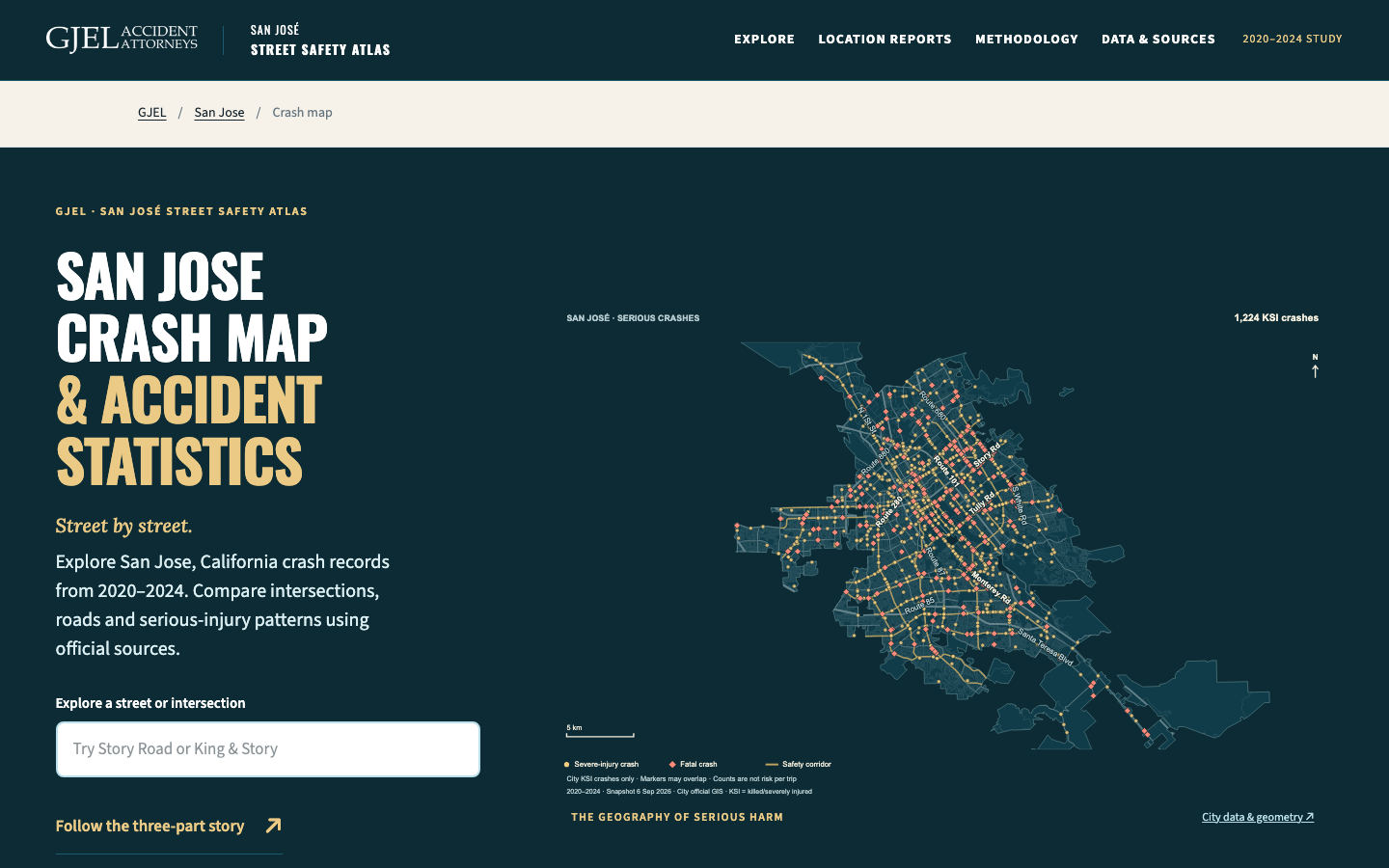
The asset leads with a recognizable visual product, not a wall of marketing copy. Screenshot: GJEL Accident Attorneys.
It does not ask the public to admire the firm. It helps people understand their city.
The asset test
Before funding a link-building idea, ask five questions:
- Is it useful without the link? A resident, journalist, researcher, or referring lawyer should have a reason to use it.
- Does the firm own the result? You should retain the research, tool, process, audience, and ability to publish updates.
- Is the evidence inspectable? Sources, definitions, limitations, and corrections should be visible.
- Can competitors reproduce it overnight? If the answer is yes, there is no moat.
- Can it produce more than SEO value? Strong assets support press, referrals, recruiting, community relationships, AI citations, and business development.
Ask what your agency will build, pitch, and maintain
A proposal promising a monthly number of backlinks is easy to compare with another proposal. It is harder to tell what your firm will own at the end. Ask the agency to show you one complete campaign: the public problem, the resource that solves it, the audiences it will approach, and who will keep the resource useful after launch.
GJEL Accident Attorneys' California total-loss calculator makes that discussion concrete. A driver can start with a California plate or enter vehicle details manually, then supply mileage, location, and damage photos. A separate flow invites drivers to submit an insurer's valuation report for review. GJEL describes the result as an informational vehicle-value estimate and says it does not take vehicle-damage-only cases. We inspected the entry screens, not a completed estimate or its accuracy.
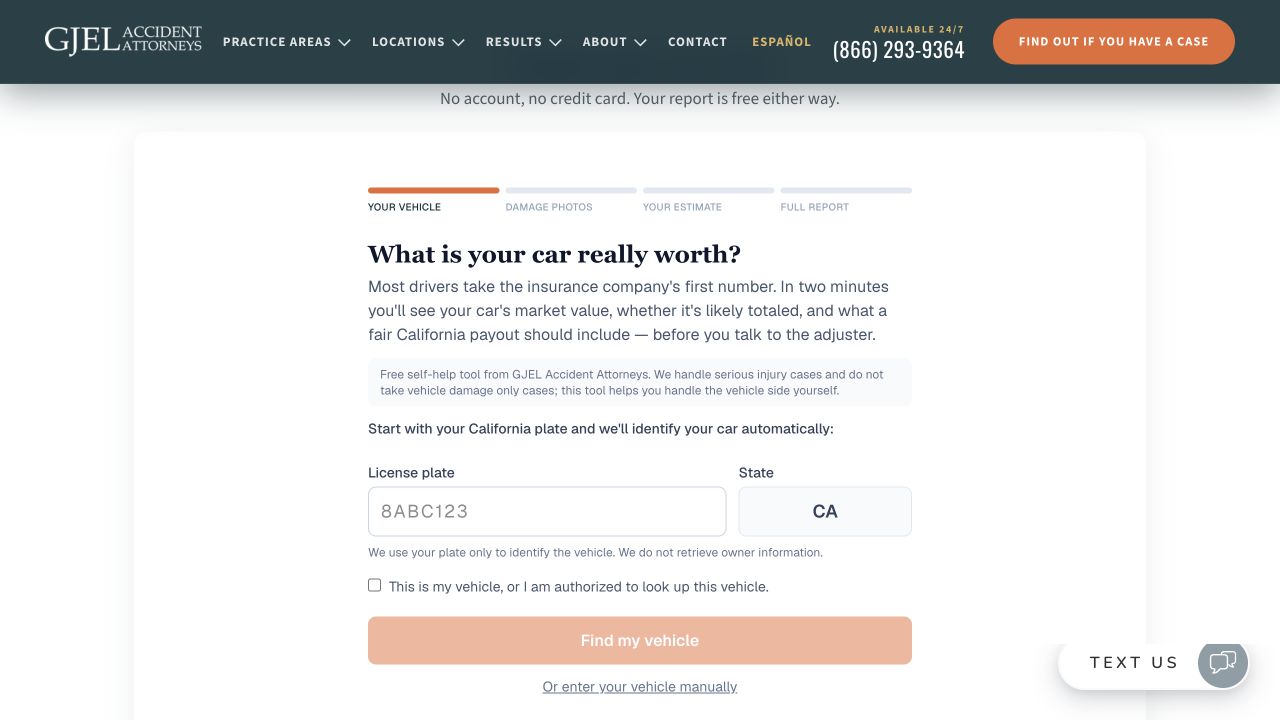
The calculator begins with the driver's vehicle, a specific question that could interest consumer and automotive publishers. Screenshot of the public entry screen; no valuation was generated.
If an agency pitched this idea to your firm, ask four questions before approving the budget:
- What will work at launch? Request a written scope for the research, design, engineering, legal review, testing, source documentation, and handoff. Check example inputs, failure states, mobile use, and the limits of any automated result.
- Why would anyone cite it? A consumer reporter might explain what to inspect in a total-loss offer; an automotive publisher might examine how vehicle details affect estimates. Each pitch needs a reader benefit and a relevant editorial angle, not a generic link request.
- What evidence will you report? Ask for a pitch log, responses, earned coverage, referral use, and corrections alongside links. Do not confuse people helped by a property-damage tool with potential injury clients.
- Who owns the second year? Assign someone to check source rules, broken lookups, confusing language, reader feedback, and opportunities for useful updates. A tool that improves can create fresh reasons for coverage.
That is a more revealing agency evaluation than a fixed link quota: your firm can inspect the work and keep building on it.
A portfolio of assets, not one heroic campaign
The best program contains three layers.
Flagship asset
One substantial resource the firm can own for years: a data explorer, annual study, public-record database, or carefully scoped calculator. This is the project that can define an association between the firm and a subject.
Utility assets
Smaller tools that solve recurring problems: a courthouse guide, official-report finder, filing-fee table, local deadline chart, records-request kit, or referral directory. These can ship faster and reveal what the audience values.
Commentary assets
Short analysis tied to new data, legislation, local news, or updates to the flagship project. These give the firm timely reasons to contact reporters without manufacturing news.
Together they create a system. The flagship attracts attention, utilities earn habitual use, and commentary keeps the work current.
Ten ideas a law firm leadership team can evaluate
- A dangerous-road atlas built from official collision records, with careful explanations of frequency versus risk.
- A court-access guide covering transport, security, accessibility, interpreters, filing windows, and verified contacts.
- A public-benefits appeal tracker summarizing published administrative outcomes and processing data.
- A legal-resource desert map showing where residents lack clinics, language access, or affordable assistance.
- A local claim-process benchmark using anonymized, aggregate time-to-milestone data.
- A zoning or permit explorer translating public records into a neighborhood-level view.
- A recurring litigation trend report based on verifiable public dockets and a disclosed classification method.
- A public-record request builder that assembles agency-specific instructions and templates.
- A consumer contract readability study comparing common documents against a published rubric.
- A referral-gap directory designed to help people the firm does not represent find credible next steps.
The right choice is not automatically the idea most closely tied to the firm's highest-value service. It is the idea with the strongest combination of public usefulness, credible firm expertise, maintainable data, and editorial interest.
Why methodology is part of marketing
Most legal content removes uncertainty from the headline and hides it in the footnotes. Original research should do the opposite. Explain what the data cannot prove.
The San Jose atlas distinguishes total crashes from crashes involving fatality or severe injury. It discloses the geographic boundary, study period, matching rules, source snapshot, and limitations. Those details are not obstacles to promotion. They are what make responsible promotion possible.
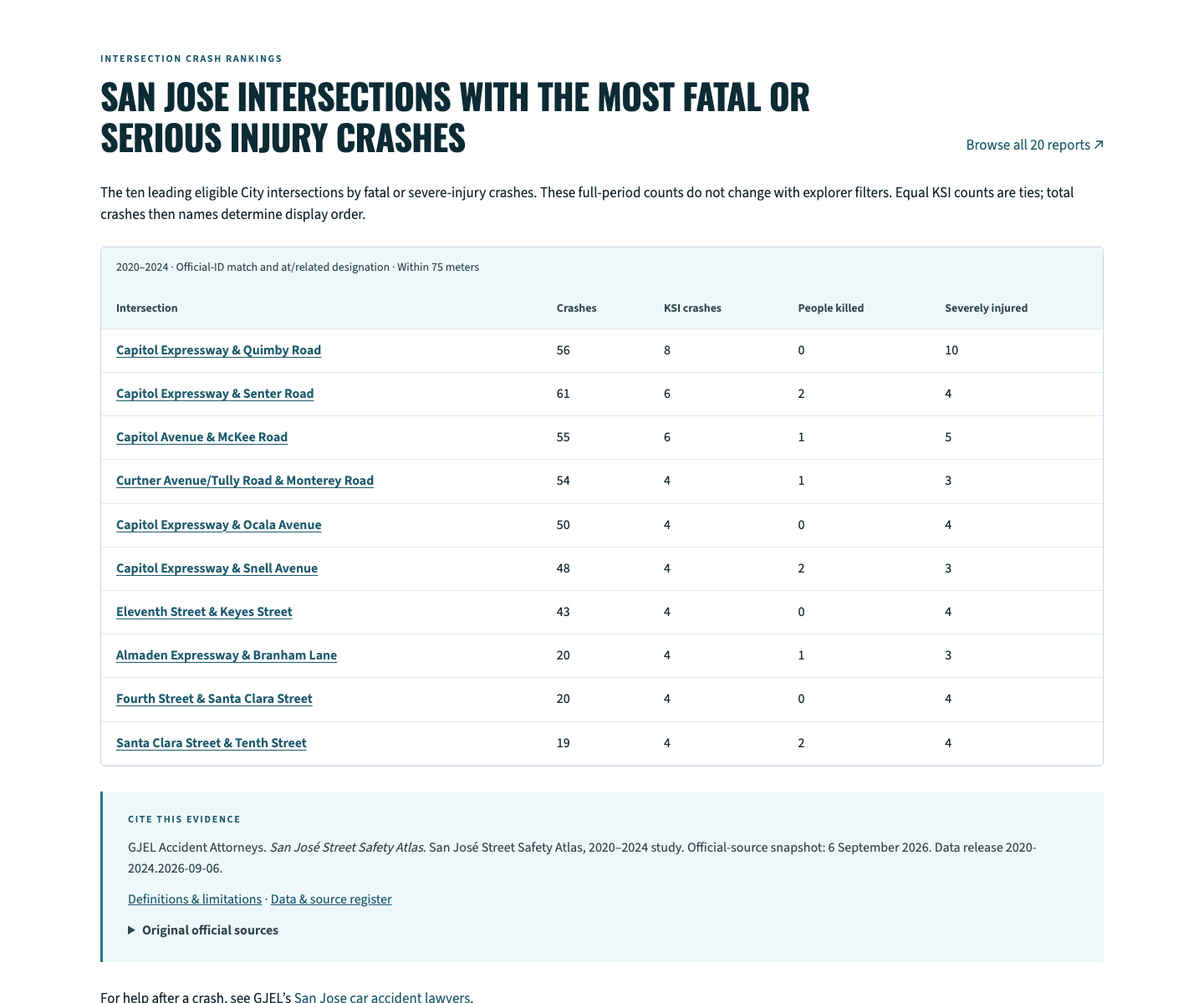
A decision-maker should fund the evidence layer as seriously as the interface. The rankings, definitions, sources, and citation format are one integrated product. Screenshot: GJEL Accident Attorneys.
For every data asset, publish:
- the original sources and access dates;
- definitions for every important measure;
- inclusion and exclusion rules;
- data-cleaning or matching decisions;
- known gaps and possible sources of error;
- the version number and update policy; and
- a visible correction channel.
This protects trust and gives sophisticated readers a reason to cite the work.
The economics are different from buying links
A purchased placement is an expense that usually stops producing value when the campaign stops. An owned asset requires more work upfront, but its components can be reused.
One research project can produce:
- a public tool;
- several local findings;
- charts and downloadable tables;
- individual location pages;
- a press briefing;
- conference material;
- newsletter content;
- annual updates; and
- a growing list of people who rely on the resource.
Measure the full return: earned links, unlinked citations, referral visits, branded search growth, media relationships, speaking invitations, assisted consultations, and the cost of producing the next edition.
A 90-day pilot
Days 1–15: Interview attorneys, intake staff, reporters, referral partners, and community organizations. Identify one local information problem that appears repeatedly.
Days 16–35: Find authoritative sources, define scope, write the methodology before analyzing the results, and have counsel review privacy and advertising issues.
Days 36–65: Build the smallest useful release. Test every claim, link, calculation, mobile view, download, and accessibility path.
Days 66–75: Prepare a concise release, findings sheet, reusable charts, citation language, and tailored outreach lists.
Days 76–90: Publish, conduct personal outreach, record questions, fix weaknesses, and schedule the next version.
Do not judge the pilot only by how many links arrive in the first week. The first release creates the asset. The next releases create the expectation that the firm is a reliable source.
The executive decision
If your current vendor disappeared tomorrow, what would the firm still own from its link-building budget?
If the answer is a spreadsheet of placements, the firm rented attention. If the answer is a useful product, original data, a recognized publication, and relationships with people who cite it, the firm built an advantage.
Everyone can buy a link. Your competitors cannot buy the years of trust created by consistently building resources the market would miss if they disappeared.